
In most environments, staff protection is part of corporate security. The structure is built around protecting employees while they perform their roles.
School staff protection operates differently.
Teachers, administrators, and support staff are responsible for students first. Their attention is directed outward. They manage classrooms, respond to behavior, communicate with parents, and maintain daily operations across the building.
At the same time, they still need to be protected. Their role does not remove risk, and their safety is just as important as the safety of students.
That responsibility changes how protection works.
Protection for school staff cannot rely on the same model used in other environments. It has to account for the fact that staff are actively involved in situations that can change quickly, often without a clear moment to disengage.
This is why school staff protection has to be built into the system around them. Staff need to know that when a situation changes, support is already in place, and they are not left to handle it alone.
Training as the First Layer of Staff Protection
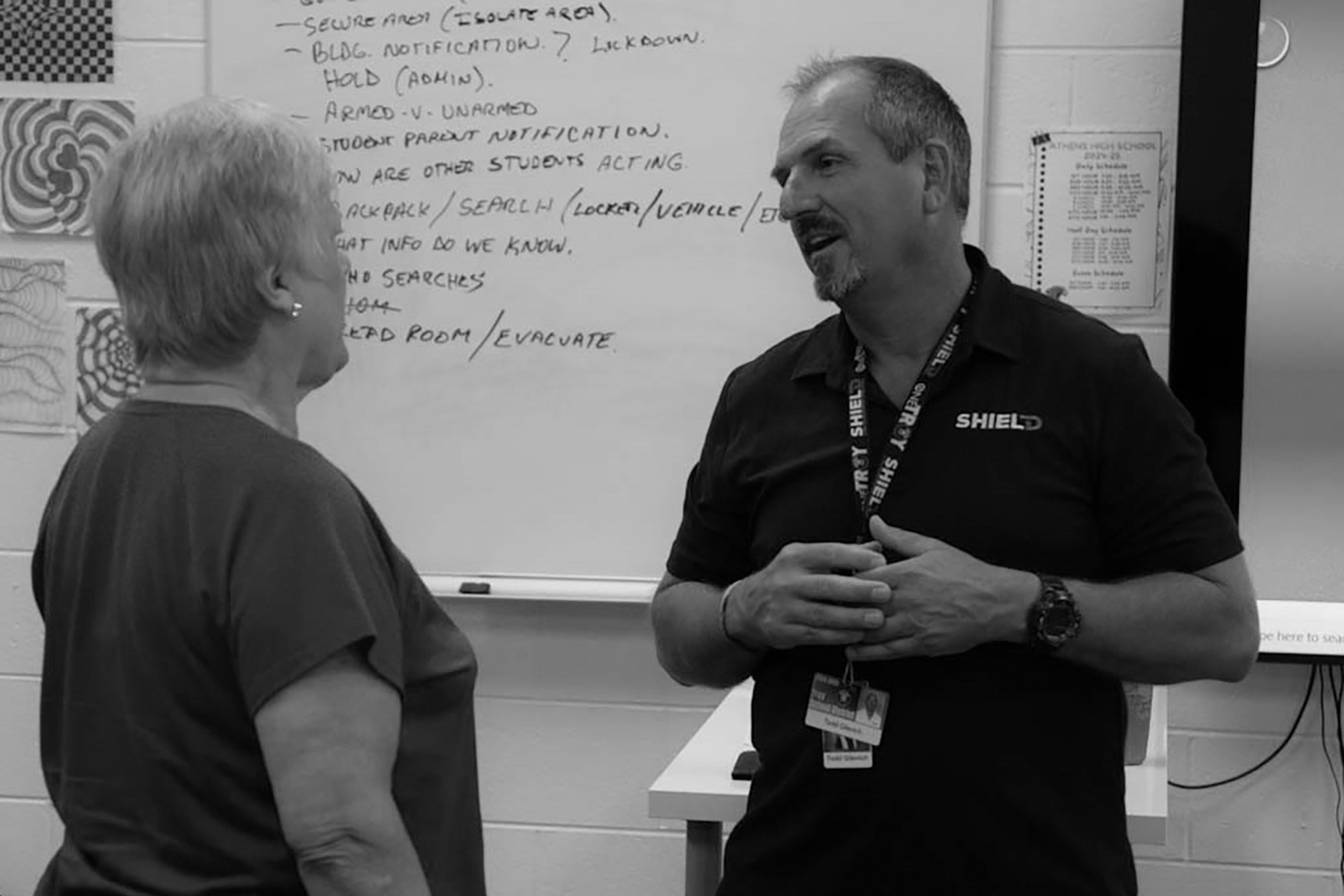
In schools, training is not only about student safety. It is part of how school staff protection is built into daily operations.
Situations that involve risk rarely begin as emergencies. They develop during normal interactions, and staff are usually the first to be involved. Training defines how those moments are handled in a way that protects both students and the people responsible for them.
The focus is not on asking staff to manage everything. It is on giving them a clear way to act without increasing exposure.
This is structured differently depending on the role.
Teachers and classroom staff are trained to manage early-stage situations while maintaining a safe environment for themselves and students:
De-escalation training – reduces the risk of conflict during student interactions
Crisis response procedures – provide clear actions during lockdowns, evacuations, and shelter situations
Situational awareness – helps identify when a situation is moving beyond classroom control
These elements protect teachers by limiting how far they are expected to carry a situation on their own.
Administrators and designated safety staff are trained to manage the building-level response:
Threat assessment processes – identify and address risks before they escalate
Crisis coordination training – ensures decisions and communication are handled under pressure
Scenario-based exercises – test how response works across the school before a real incident occurs
These elements protect administrators by giving them a defined structure for decision-making and coordination.
This separation of training is what makes protection work.
Staff are not left to rely on judgment alone. They operate within defined limits, supported by a system that prepares them for situations they are likely to face.
A school safety management system, guided by a director of safety and security or school safety consultants, connects this training to real conditions inside the building and ensures that staff protection is part of how the school operates every day.
How Security Guards Protect School Staff
In schools, the role of security is not limited to supervising students. It includes protecting everyone working in the building.
This becomes relevant when situations move beyond routine interaction. Staff remain part of the environment, but they are no longer expected to manage conditions that carry risk.
That is where trained security guards take responsibility.
Their role is built around protecting staff while maintaining control of the situation:
Controlled intervention – stepping into interactions when escalation moves beyond staff responsibility
Positioning and presence – managing space to reduce pressure and prevent situations from spreading
Movement control – limiting access to the area so staff are not drawn into the situation
Support for staff – allowing teachers and administrators to step back while the situation is stabilized
These actions are based on training, not reaction.
Security guards are prepared to recognize when conditions change, how to enter a situation without increasing tension, and how to maintain control without disrupting the rest of the school environment.
This applies across different types of interactions. Student behavior, parent conflicts, and unexpected incidents all require a controlled response that protects staff from direct exposure.
Within a school safety management system, security guards operate with defined responsibilities that align with training and school procedures.
SHIELD’s trained security guards follow this approach, with a focus on protecting school personnel as part of daily operations, not only during emergencies.
How Safety Leadership Protects School Staff
Now, let’s talk about who is responsible for building protection into the system. This is the role of a director of safety and security.
Their job is to make sure that school staff protection is defined and consistent across the building.
This starts with how roles are structured. Teachers, administrators, and security guards are not expected to respond the same way. Each role is defined with clear limits, so staff are not placed in situations that increase exposure.
This is built through:
Role definition – setting clear boundaries for teachers, administrators, and security personnel
Training structure – preparing staff to handle early situations without managing escalation alone
Security staffing – hiring and placing guards where staff interaction carries higher risk
Response protocols – defining when situations shift from supervision to security involvement
Coordination with responders – aligning school procedures with law enforcement expectations
These elements work together.
Staff are not left to decide how far to go in a situation. The system defines it, and support is already in place.
A school safety management system, led by a director of safety and security, ensures that protection is part of how the school operates every day.
Conclusion
Everyone in the school deserves to be protected.
Teachers and administrators should not feel responsible for everything that happens in the building. Their role is to teach, manage, and support students. Protection comes from knowing there is structure behind them and support in place when situations change.
This is where training, security protocols, and safety leadership work together.
They create a system where staff can focus on their responsibilities without being pulled into situations that carry risk.
When that system is in place, the school operates as it should.
If your school is looking to build that level of protection, let trained security personnel handle safety. Contact SHIELD to create a system your staff can rely on every day.