
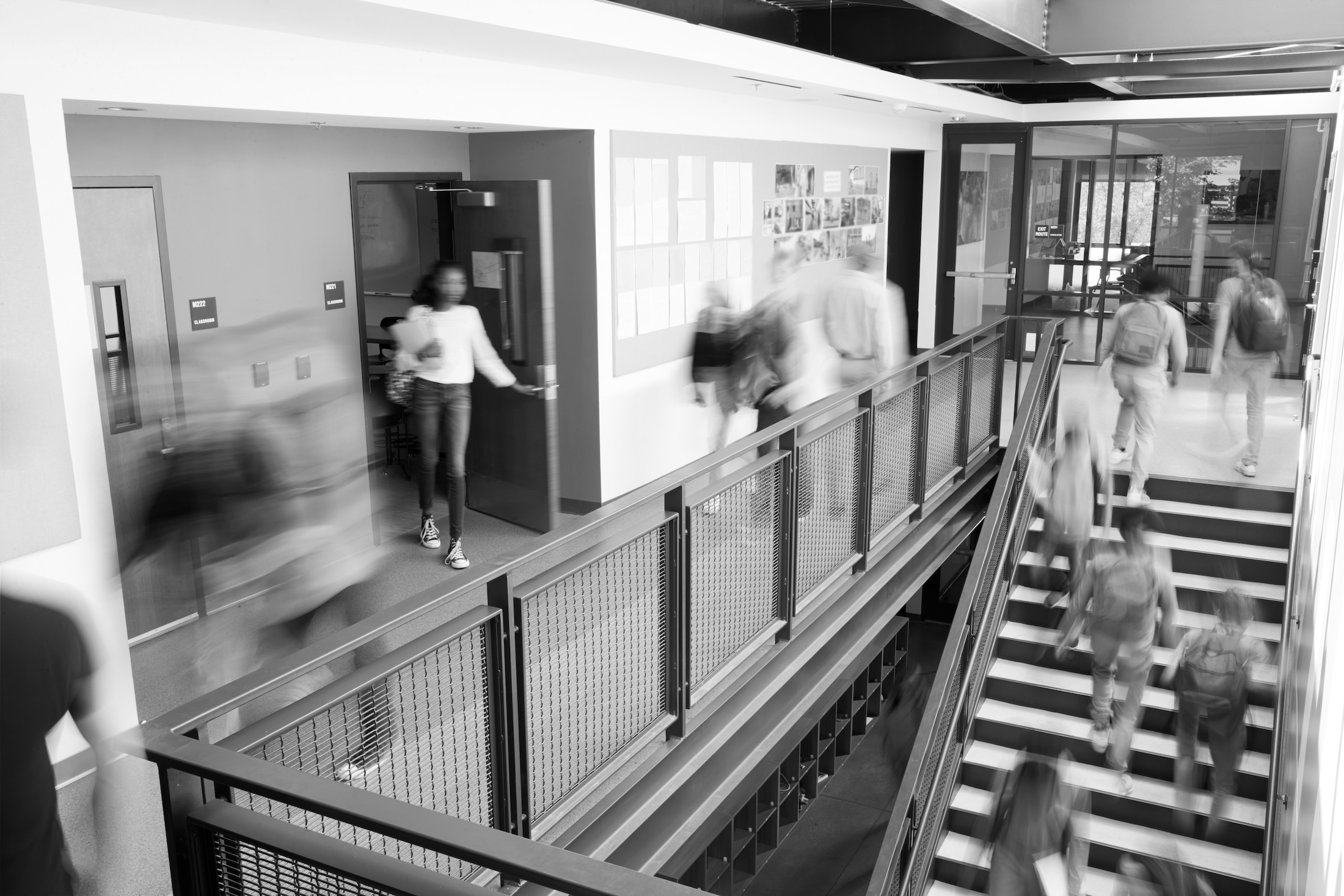
Class transitions are one of the most compressed and demanding moments in the school day. Within a few minutes, hundreds of students move through shared spaces, often with limited supervision and little margin for error. While hallways may appear routine, they consistently present challenges for school safety and security.
Unlike classrooms, hallways are transitional by design. Movement is constant, expectations vary by age group, and interactions happen quickly. These conditions make hallways a common location for incidents that escalate before staff can respond.
Why Hallway Transitions Create Risk
Between classes, hallways change character almost instantly. What was a quiet corridor minutes earlier becomes a moving crowd, filled with students heading in different directions, stopping at lockers, or trying to reach the next class on time. For a short window, the school operates without the structure that exists inside classrooms.
The central challenge during these moments is not individual behavior, but volume. When entire classes are released at once, hallways fill beyond their intended capacity. Space tightens, movement slows, and physical proximity becomes unavoidable. In these conditions, even routine actions require negotiation.
Overcrowding as the Starting Point
Overcrowding sets the stage for most hallway incidents. Bottlenecks form near locker banks, stairwells, and classroom doors. A brief pause by one student affects dozens behind them. Frustration builds as movement becomes unpredictable.
Small disruptions ripple quickly through the crowd. What would be inconsequential in an open space can feel intentional when students are packed together and under time pressure.
Speed, Direction, and Conflicting Goals
Within crowded hallways, students move with different priorities. Some are rushing to avoid being late. Others slow down to talk, wait for friends, or access lockers. These competing goals collide in narrow corridors and intersections.
When fast-moving students meet resistance from those standing still, tension rises. A verbal comment or physical adjustment can escalate quickly when there is no space to step away or reset.
Reduced Accountability During Mass Movement
During passing periods, students are temporarily detached from a specific classroom or supervising adult. Oversight becomes dispersed across a large space, and accountability feels less immediate.
In crowded hallways, intent is also harder to read. Accidental contact and deliberate actions often look the same in the moment. Misinterpretation happens quickly, and reactions follow before clarification is possible.
Identifying Pressure Points Through a School Safety Audit
Hallway incidents tend to repeat in the same locations, not because of chance, but because of design, scheduling, and movement patterns. A school safety audit allows schools to identify where transition risks consistently emerge and why those locations become pressure points during passing periods.
This type of review looks beyond isolated incidents and focuses on how students actually move through the building day to day. At SHIELD, security directors conduct these audits by observing real transitions, tracking congestion patterns, and identifying areas where escalation is most likely to occur.
Structural Bottlenecks and Design Limitations
Certain physical features create predictable congestion:
- Locker banks clustered near intersections
- Stairwells feeding into narrow corridors
- Classroom doors opening directly into high-traffic zones
These design elements force students to slow, stop, or merge unexpectedly, increasing frustration and physical contact. Audits help schools map these bottlenecks and understand how layout influences behavior during passing periods.
Timing and Flow Analysis
Risk is also influenced by timing. Short passing periods, synchronized class releases, or uneven stair access can overload specific hallways while leaving others underused.
A safety audit examines how long students realistically need to move between classes and whether schedules unintentionally concentrate traffic. In many cases, small adjustments to release timing or hallway routing reduce pressure without adding supervision.
Supervision Placement Gaps
Audits frequently reveal that staff and security coverage is strongest at entrances and weakest at interior intersections. These gaps matter. Incidents are more likely to escalate where visibility drops and response time increases.
By identifying these blind spots, schools can align supervision with actual movement patterns rather than assumed risk areas.
The Role of Security Guards in Transitional Spaces
Security guards operate differently during hallway transitions than in static environments. Their effectiveness depends less on enforcement and more on positioning, movement, and situational awareness during short, high-density periods.
Visibility as a Stabilizing Factor
In hallways, visibility functions as a behavioral signal. When students can clearly see security guards positioned at known pressure points, behavior often self-regulates. Inconsistent or unpredictable presence, by contrast, can create uncertainty and invite boundary testing.
Security guards are most effective when their placement is intentional and consistent across transitions.
Movement vs. Stationary Monitoring
Standing in one location limits awareness in dynamic spaces. During passing periods, security guards often need to move deliberately through corridors rather than remain fixed. This movement allows them to identify early escalation cues that stationary monitoring may miss.
School security environment consultants like SHIELD emphasize a balance between fixed positioning at known pressure points and controlled movement through high-traffic zones, allowing guards to monitor hallway flow without disrupting it.
Coordination With Staff
Security guards are only one part of hallway supervision. Without coordination with teachers and administrators, responses can become fragmented. Clear role definition helps ensure that guards are not pulled into reactive situations that could have been addressed earlier through staff intervention.
When expectations are aligned, security guards support hallway flow rather than becoming the focal point of disruptions.
Conclusion
Hallway transitions expose the moments where schools are most vulnerable to escalation. Overcrowding, limited visibility, and divided supervision create conditions where small disruptions can grow quickly. These risks are not the result of isolated behavior, but of how space, time, and movement intersect during passing periods.
Strengthening school safety and security in hallways requires understanding where pressure points form, how supervision functions during transitions, and how security guards and staff operate together in high-density environments. When schools address hallway movement as a system rather than a series of incidents, they are better positioned to reduce escalation and maintain control during some of the busiest moments of the day.