

Establishing strong, professional connections with local mental health providers is a critical part of any effective school safety and security strategy. By proactively learning about regional resources, admission criteria, and care options, district leaders can strengthen both prevention and crisis response efforts. These partnerships support timely and appropriate referrals, enhance staff readiness, and help foster a school culture that prioritizes mental wellness as part of a safer learning environment.
Mental Health as Part of a School Safety Management System
While partnerships with mental health providers are essential, their impact is greatest when woven into a broader school safety management system. Safety today requires a layered approach that considers not only facilities and physical protocols but also the emotional health of the school community.
Mental health-related incidents often surface as behavior changes, absences, or interpersonal conflict. A responsive system needs clear communication channels, defined roles, and accessible care pathways. When mental health resources are integrated into the school safety management system, schools can act with greater coordination. This allows them to identify risks earlier, stabilize situations faster, and reduce long-term disruption for students and staff.
This approach strengthens a district’s ability to both prevent incidents and manage them effectively when they occur. After all, the best school incident is the one that never happens, and a well-connected mental health network helps make that possible.
Why Mental Health Checklists Matter: Impact & Benefits
- Strengthens professional relationships with providers, improving crisis coordination
- Ensures timely, accurate referrals for students or staff in need
- Supports the development of a comprehensive Employee Assistance Program (EAP)
- Enables schools to provide clear, vetted referral lists to families
- Reduces stigma by normalizing mental health support through visible partnerships
- Eases stress for families by offering well-informed, local care options
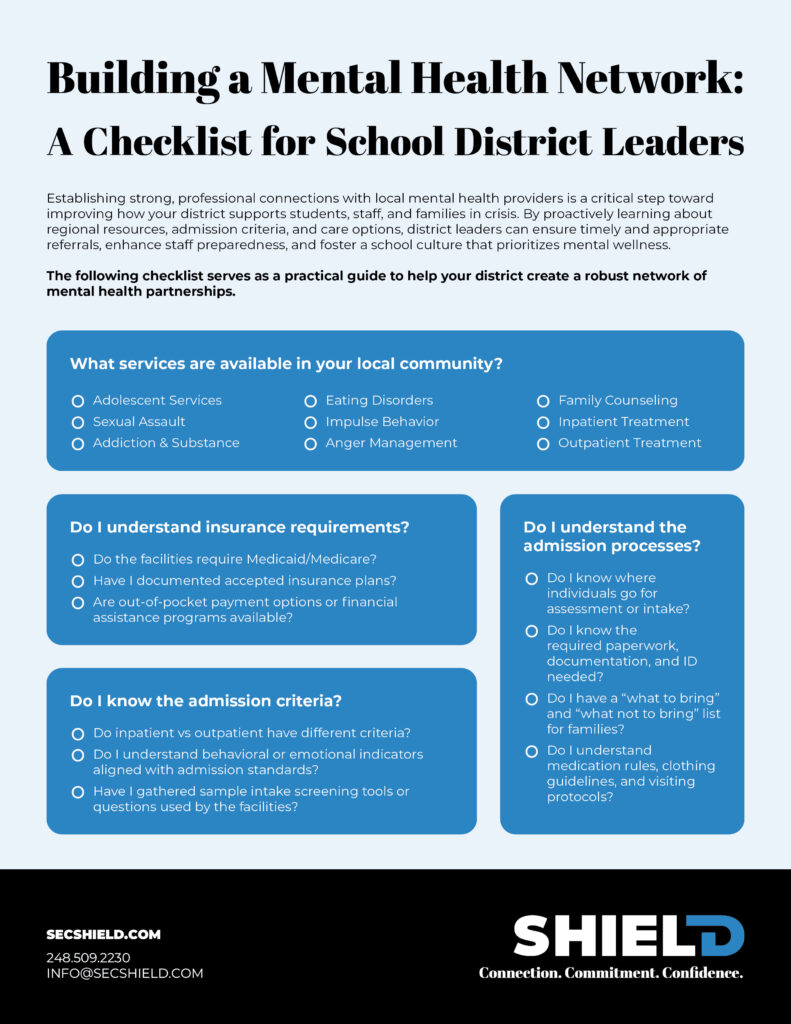
The checklist below serves as a practical guide to help your district create a robust network of mental health partnerships.
In Conclusion
Building a reliable mental health network is one part of a larger safety strategy. Your district’s ability to prevent incidents, respond to crises, and support your community depends on having trusted systems in place.
As your school safety consultants, SHIELD’s security directors help lead and manage every layer of your safety operation — from mental health coordination and emergency planning to on-site response and staff training. We invite you to explore the full scope of our responsibilities and see how we support districts like yours across Michigan.